My eyes were as big as the moon when the orderly wheeled in the new Bipap machine for the Baby. The machine looked like someone had told a child, ‘Draw a Transformer with no arms and octopus feet with wheels and a heavy boxy head with a screen face’ and then brought it to life.
I stared at it, mouth agape, and immediately wanted to punch someone.
“We think he needs this,” the Doctor stated plainly, like he was talking about a sandwich, his bobblehead medical students nodding behind him.
We were already multiple days into one of the many, many hospital stays when the Baby was much younger. And we weren’t even in one of the primo rooms this time. D9 is where it’s at, baby- the respiratory floor. A cheery train themed elevator, with its railroad-themed wallpaper and toy train running endlessly on a railroad track, takes you up up up to a hallway so bright it could very well be heaven. The views of downtown Dallas from the hospital rooms would easily get a 5-star rating on Yelp. The suites are expansive. The private bathrooms, spacious. The patient kitchen is shiny and bright and well-stocked with plastic spoons and boxes of apple juice. The air feels fresh and clean, like the elevator doors opened upon a dewy meadow.
No, now we were on some ungodly floor like V492. No whimsical train elevator for us. We took the plane elevator to the basement. In the dank bowels of the large hospital complex, we dragged our oxygen tanks and loud beeping monitors behind us like a bedraggled wagon on the Oregon Trail–past the the cafeteria, smelling of oil and sanitizing fluids, past the expensive vending machines, past a wheelchair graveyard to a creaky elevator shaft next to the janitor’s closet. “Here’s your elevator,” the nurse’s aide hissed at us as we stood forlornly under a flickering, fluorescent light.
The view from our dirty window faced a very narrow atrium that had been carved into the architecture of the building so us lowly peasants could have a “view”. There was evidence of pigeons on the concrete window sill; their fecal matter and feathers left behind in pursuit of a better, gentler place to live. If we peeked too far over the edge of the sill, we could spot dead pigeons, their stiff bodies frozen seemingly in mid-flight. The plasticky couch was too short for a regular-sized person to sleep on comfortably. The bathroom was weirdly humid, like the large heavy door was a portal from the frigid room to a tropical jungle that smelled like a medical fart.
The inciting incident for this particular hospitalization had been a mysterious rash that emerged from The Baby’s skin like angry fault lines of tiny volcanoes. He himself had transformed from our happy floppy baby to a tiny screaming volcano. We’d already been to the ER once over this issue but they had sent us home with a cream and a prayer, neither of which had worked.
So here we were again, punching our frequent flier card–almost to that free slice of gelatinous cherry pie from room service– dragging a screaming boy on oxygen into the Emergency Room. Again.
For this second visit, the Emergency Room doctor misdiagnosed the rash as measles and alerted the health department, who promptly scared the shit out of our daycare lady about her in-home daycare being ground zero for a nationwide pandemic. It was the medical rendition of “The sky is falling!” We felt as if we were waiting for SWAT helicopters to descend and stick us in a quarantine bubble, the press gathering outside the clear plastic igloo to hurl questions at the irresponsible parents of an infant who caused a national incident.
Eventually, the powers that be at the hospital decided that the problem was not a highly-contagious, Depression-era disease and decided to admit him to study the rash instead.
A day or two of IV antibiotics mostly cleared the rash but now there was Another Problem. Carbon dioxide levels in the Baby’s blood were too high in the mornings, indicating that he wasn’t expelling it well enough while he was sleeping. After he fell asleep, the pulse-oximeter, attached to his big toe with a tiny ace bandage, was alarming frequently when his oxygen fell below a certain number. All this, even though he was receiving oxygen through his nasal canulae at night.
So the infuriating floor doctor rolled in this behemoth contraption and said glibly that we should “just” add this to our medical menagerie.
Oh, the doctor also delivered the news that starting on a bipap would mean several more nights in the Crypt of the Dead Pigeons, while they figured out the best settings for him. When the doctor and his students, like little ducks in a row, filed out and the door banged shut behind them, I hurled my phone across the room where it slammed into the wall and fell behind the teal and purple loveseat.
The only witness to this tantrum, aside from the nonverbal baby who had no feeling one way or the other about the bipap machine, was my dad who followed the arc of my phone with wide eyes and then exclaimed in disbelief, “Was that your phone?!” while I fell into a pile of tears on the cracked tiled floor.
That first night, they tried to wrangle the Baby into a full face mask, a vaguely triangular plastic mask suction cupped to the face of what appeared to be a tiny, rage-filled astronaut. We didn’t sleep much that night. The machine alarmed all night long. He would wake up screaming from behind his mask. Save me, he must have meant. Save me from this misery.
The next night, they switched to a mask that only covered his nose and he did a little better, but not as much as they wanted. The Baby’s chronic mouth breathing thwarted some of the machine’s magic, his own little Fuck You to the medical establishment.
After a few days, the bipap quieted a little, the settings finally closer to what they needed to be. On day 11 of our stay, we got to go home.
And so the Kid, about 11 years old at the time, rode the $12,000 piece of equipment like a skateboard down the tilt of the parking garage towards the next chapter of our lives at home.
That was seven or eight years ago. And we learned to live with the armless Transformer. Like many disabled people and their caretakers, we figured shit out. I crafted an apparatus out of foam blocks to keep him from rolling onto his stomach and smashing the exhalation valve of his mask into his mattress and causing the alarms to scream. We figured out the best way to put the mask on without waking him. We learned how to hack into the stupid fucking thing to turn the most egregious alarms off, shushing them sarcastically. “Blah-blah-blah. He’s a mouth-breather. We get it,” we metaphorically told the screeching alarm harpies as we used secret passcodes and hand motions to get into the settings meant for professional eyes only.
We fretted about traveling with the Bipap. Altogether, it–the pole on wheels, the water humidifier machine, the large wire basket with hooks, the bipap itself–weighed two thousand pounds. We’d need a U-haul truck just to get it around. But, in a moment of desperation, I asked the Durable Medical Equipment guy about it and he handed me a travel circuit, which meant we could jettison everything but the robot head when we traveled. And so we did.
We did sleep studies, which are semi-regular nocturnal appointments where Alex wrangles an angry Baby wearing a showercap with wires sticking out of it like Medusa, hopefully lulling him to sleep so they can study The Baby while he dreams. Lo and behold, one sleep study revealed that The Baby was keeping his oxygen saturation up without needing extra oxygen pumped in. Which meant that we could nix the hulking blue suit-cased-sized box that farted heat in the hall closet all night.
We have taken three separate flights now with the stupid bipap that weights 32 pounds and digs into our shoulders. We have to go through special TSA security and they always wipe the machine down with their weird little make-up sponges before compressing them into a woo-woo machine that beeps to tell us the bipap is still harmless.
In November, The Baby hit 65 pounds at a doctor’s appointment. I immediately texted Nick, our Durable Medical Equipment supply guy, because I knew that meant that The Baby could graduate to a smaller machine. In December, I texted Nick more than my mom, just trying to coordinate doctor’s orders and insurance approvals.
Yesterday, Nick showed up in a van the same shape as a milkman’s. He carried in a small, soft-sided case. I clapped my hands giddily. The case was so tiny–miniscule, really. Maybe only three juvenile squirrels could fit inside.
Nick and I and my sister mom the Baby’s nurse all traipsed into The Baby’s room where he was laying on the floor in the sunshine pushing the buttons on his favorite toy remote. Nick set the case on the dresser and, with theatrical flair, pulled out a machine that is roughly the size of a box of Saltines.
It was lighter than a loaf of bread. I held it aloft in the air like Rafiki in the Lion King. I ran upstairs to grab a shelf and barged downstairs with it hefted over my shoulder like a much younger woman. Goodbye, evil computer head. Goodbye, beeping humidifier nightmare. Goodbye, squid-arm-wheeled Festivus pole that weighed 1000 pounds, I thought with glee as I ripped the plugs out of the wall.
Before shoving the machine out of the space and out of our lives, I took a picture of The Baby, who was very annoyed at the interruption, sandwiched between the old and the new, a fresh chapter in the making.
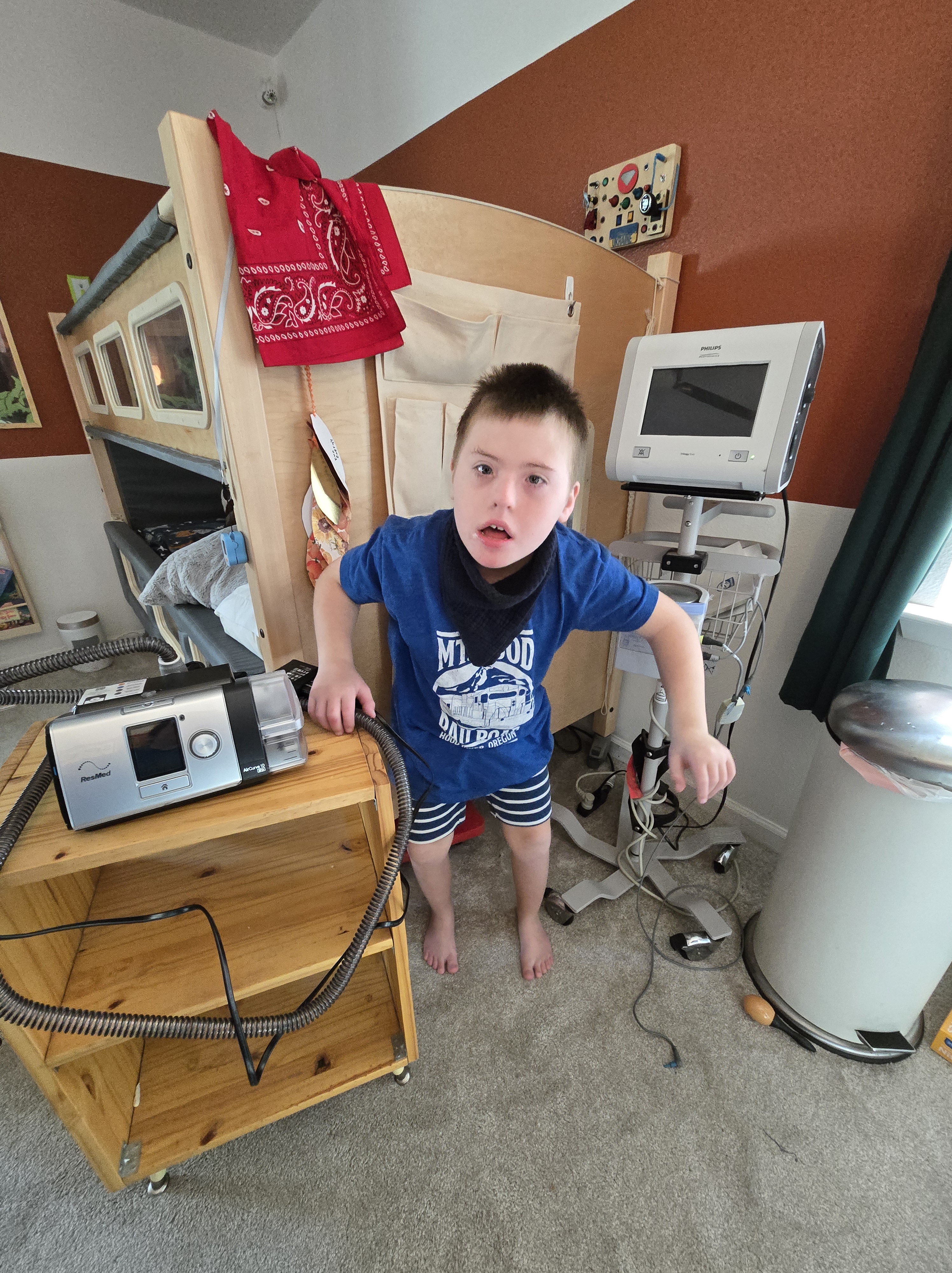
Having said my goodbyes, I kicked the evil machine and plunked the shelf in its new spot, placing the new, tiny Bipap in its place of honor, briefly contemplating installing a spotlight that would shine on it in the darkness, dear thing that it is.
Nick rolled the old behemoth out to his milkman van to cart it away for the next poor family. And that was that.
Last night, after we hooked The Baby up to his mask and turned on the quiet, diminutive machine, I asked myself, Did we need that colossus? Was that whole thing necessary? Begrudgingly, the answer is yes, The Baby needed it for a time. But now he’s bigger and stronger and better. It was time for us to move on, say goodbye, and slam the door on our Giant Bipap Era.
As 2025 looms, I find myself wondering what else needs to go. Life is getting easier. How many other hulking things have I been carrying around needlessly, ruining my back, hunched in an herculean effort to make all this work? There’s no mystical equipment man to come to my house and take these burdens away from me in his magical milk truck.
I’ve got to take this shit out myself.
So, in 2025, I’m setting some lofty goals to clear out the old and make way for the new.
Farewell, people-pleasing and shame-motivated behaviors. Good bye, lack of boundaries and self-doubt. Imposter syndrome, be gone! Out with all of you. There’s no room for you here. It’s time to move on.
We’re getting better, lighter, stronger over here.
 welderbeth